


Tmannings
July 30, 2026
Tottenham, Tudor, and the hidden cost of football chaos
Igor Tudor prowls the touchline, barking instructions. The shape looks unfamiliar, the bench is thin, and every match feels slightly improvised. It looks like a club scrambling for stability. Which, in a way, it is.
But the interesting thing about Tottenham’s current chaos is that it didn’t start with Igor Tudor. In fact, it didn’t start this season. Or even last season. The seeds were planted years ago. Different managers arrived with different ideas, recruitment strategies shifted, squads were rebuilt for tactical systems that didn’t last and slowly, almost imperceptibly, the club drifted into instability. Tudor hasn’t created Tottenham’s chaos. He’s been asked to stabilise it. And that raises a broader question.
How much does organisational instability actually hurt football clubs?
Is chaos simply part of modern football? Or does it quietly undermine performance over time?
The idea
Football talks about stability constantly. Every new manager promises it. Every sporting director references it. Every ownership group unveils some version of a “long-term project”. Yet football itself rarely behaves that way.
Managers are sacked after three bad weeks. Squads are rebuilt every transfer window.
Tactical identities shift every season. Clubs talk about stability. But football often runs on chaos – and sometimes that chaos appears to work. Chelsea change managers and win trophies. Watford built an entire model around managerial turnover. Marseille seem to oscillate between crisis and success every few seasons.
So the question is simple:
Does organisational chaos actually hurt performance?
Or is stability just something clubs say because it sounds sensible?
Measuring football chaos
To explore that question, I built a dataset across global football leagues and constructed a metric I’m calling the Football Chaos Index. The idea was deliberately simple: Measure instability then see what happens next.
Organisational chaos in football tends to show up in two places.
-
Squad Instability: Players constantly arriving and leaving.
-
Managerial Instability: Frequent coaching changes.
Both disrupt systems. Players need time to settle, managers need time to embed tactical ideas and recruitment strategies shift with each regime.
So the Chaos Index combines three signals:
-
– Squad turnover
-
– Manager changes
-
– Interim manager usage
To avoid penalising leagues where turnover is naturally higher, the metric measures relative chaos, how unstable a club is compared to the norm in its league.
What chaos actually looks like
When you rank clubs by organisational chaos, the results aren’t all that surprising, with many of the most chaotic clubs globally sharing similar characteristics:
-
– Very high squad turnover
-
– Frequent managerial changes
-
– Financial or ownership instability
Clubs like:
-
– Türkgücü München
-
– Real Murcia
-
– AFC Eskilstuna
-
– SV Straelen
don’t just experience occasional turbulence – they live in it. The chaos index captures this. But ranking chaos is only the starting point.
The more interesting question is:
What does chaos actually do to performance?
Chaos today, results tomorrow
To answer that, I ran a regression predicting next season points per match.
The key result:
relative_chaos_index = -0.0023
p = 0.001
Meaning:
The more unstable a club is this season, the worse it is likely to perform next season.
The relationship holds even when controlling for:
-
– league differences
-
– country effects
-
– seasonal variation
So instability isn’t just noise, it’s predictive.
The Football Chaos Curve
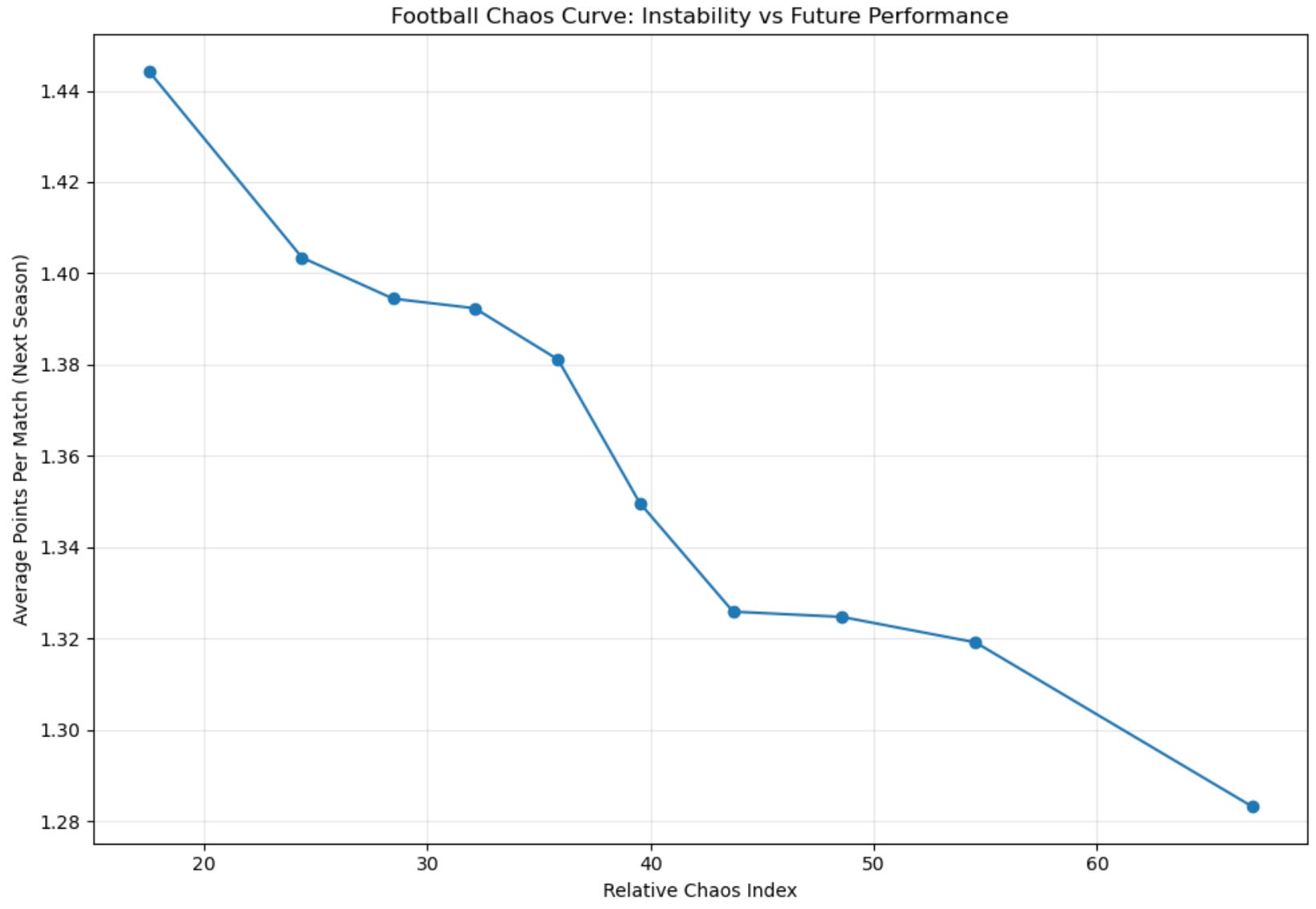
Instability doesn’t just create volatility.
It creates decline.
When clubs are grouped by their level of instability, a clear pattern emerges.
– At low levels of chaos: Clubs average roughly 1.5 points per match the following season.
– At high levels of chaos: That drops to roughly 1.1 points per match.
– Across a full season, that’s a swing of around: 15–17 league points.
Which is the difference between:
-
– competing for continental competition
-
– mid-table safety
-
– or a relegation battle
Chaos doesn’t just create volatility – it creates drag.
Why chaos hurts
There are a few obvious mechanisms.
-
Managers bring tactical systems.
-
Recruitment follows those systems.
-
Clubs build knowledge over time.
When those elements reset repeatedly, coherence disappears.
If you want a live case study, you could simply watch Manchester United over the past decade.
Stability, and why it works
Once you step back, the contrast is striking. Some clubs operate in near-constant instability while others remain structurally stable over long periods. The stable group tends to include clubs widely considered best-in-class:
-
– Bayern Munich
-
– Manchester City
-
– Real Madrid
-
– Benfica
These clubs still evolve, they change managers, they refresh squads but they do so within a consistent framework.
Recruitment aligns with identity – Managers fit the model – Knowledge accumulates rather than resets.
And that compounding effect matters.
The stability paradox
Football culture often romanticises chaos.
There’s a belief that dramatic change unlocks performance.
“New manager bounce.”
“Fresh start.”
“Reset the dressing room.”
And occasionally it does. But zooming out, those effects tend to be temporary. Across leagues and seasons, stability wins more often than chaos. Not because stable clubs avoid change, but because they manage change without losing coherence.
Chaos across world football
The most chaotic clubs in world football aren’t just unlucky – they share structural patterns.
High player turnover, short managerial tenures, and unstable ownership models combine to create environments where instability isn’t occasional.
It’s systemic.
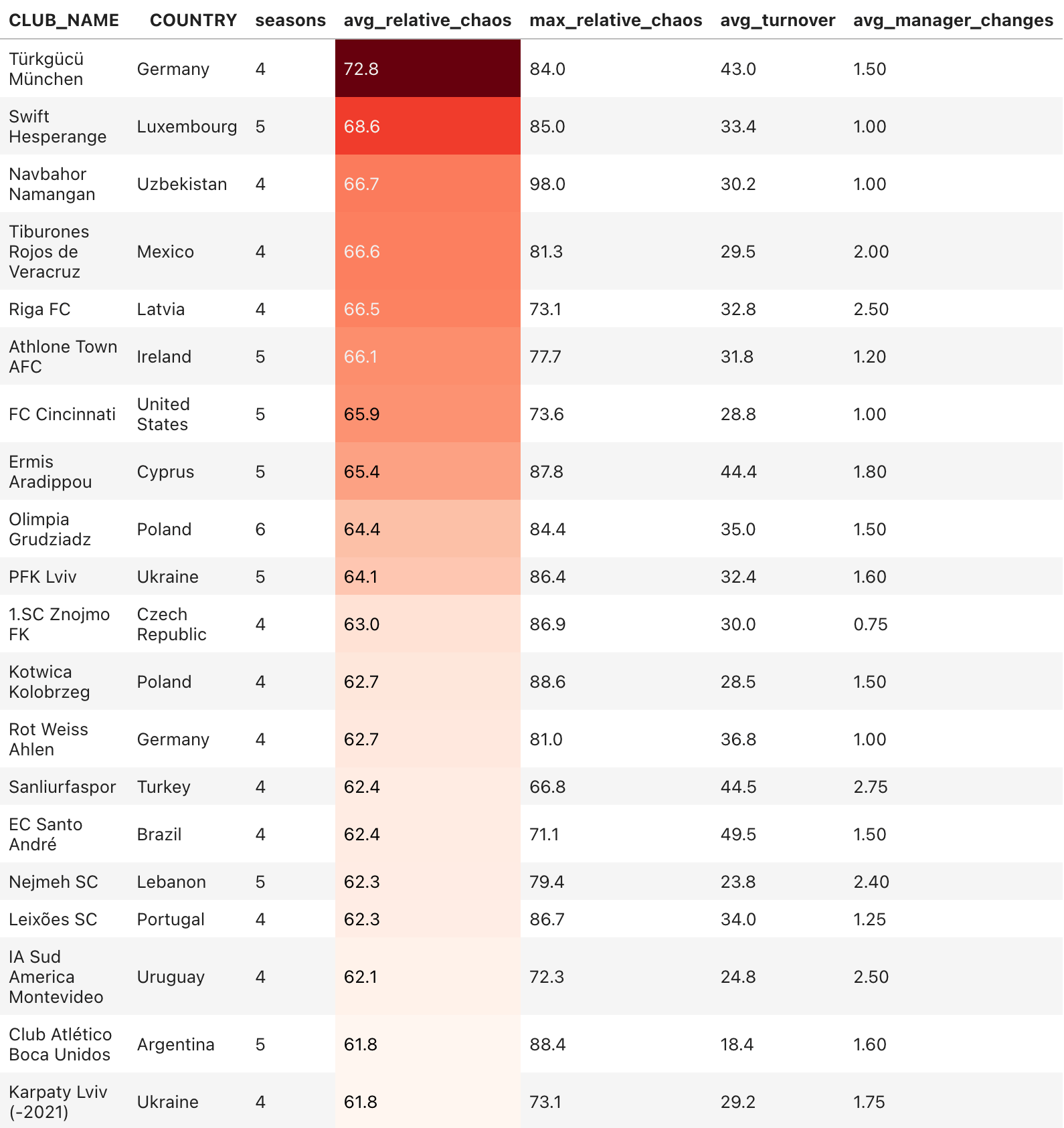
When you map chaos globally, some clubs stand out immediately. These aren’t just clubs that had one bad season. They are organisations where instability is structural. But what’s striking is how that instability shows up.
It’s not always constant managerial sackings. Across the most chaotic clubs, player churn is consistently extreme. Entire squads are effectively rebuilt every season, often without a coherent long-term plan.
Managers do change – but less dramatically than you might expect.
Instead, many clubs sit in a middle ground of:
-
– moderate managerial turnover
-
– extreme recruitment turnover
The result is squads assembled for multiple tactical ideas, across multiple time horizons, all at once. Patterns repeat:
-
– ownership turbulence
-
– reactive recruitment strategies
-
– short-term planning
-
– constant squad reset
In some environments, this isn’t even exceptional. It’s normal.
Leagues with financial instability or high promotion pressure tend to produce clubs where churn is built into the system. Players move constantly. Planning horizons shrink. Decisions become reactive. Chaos, in most cases, isn’t accidental. It’s the business model.
The most chaotic big-league clubs
Global rankings are useful, but they can feel abstract.
Filtering down to Europe’s major leagues makes the pattern easier to recognise – because the names become familiar, and the instability becomes harder to ignore.
A few patterns emerge quickly – and some of the names are not necessarily the ones you’d expect.
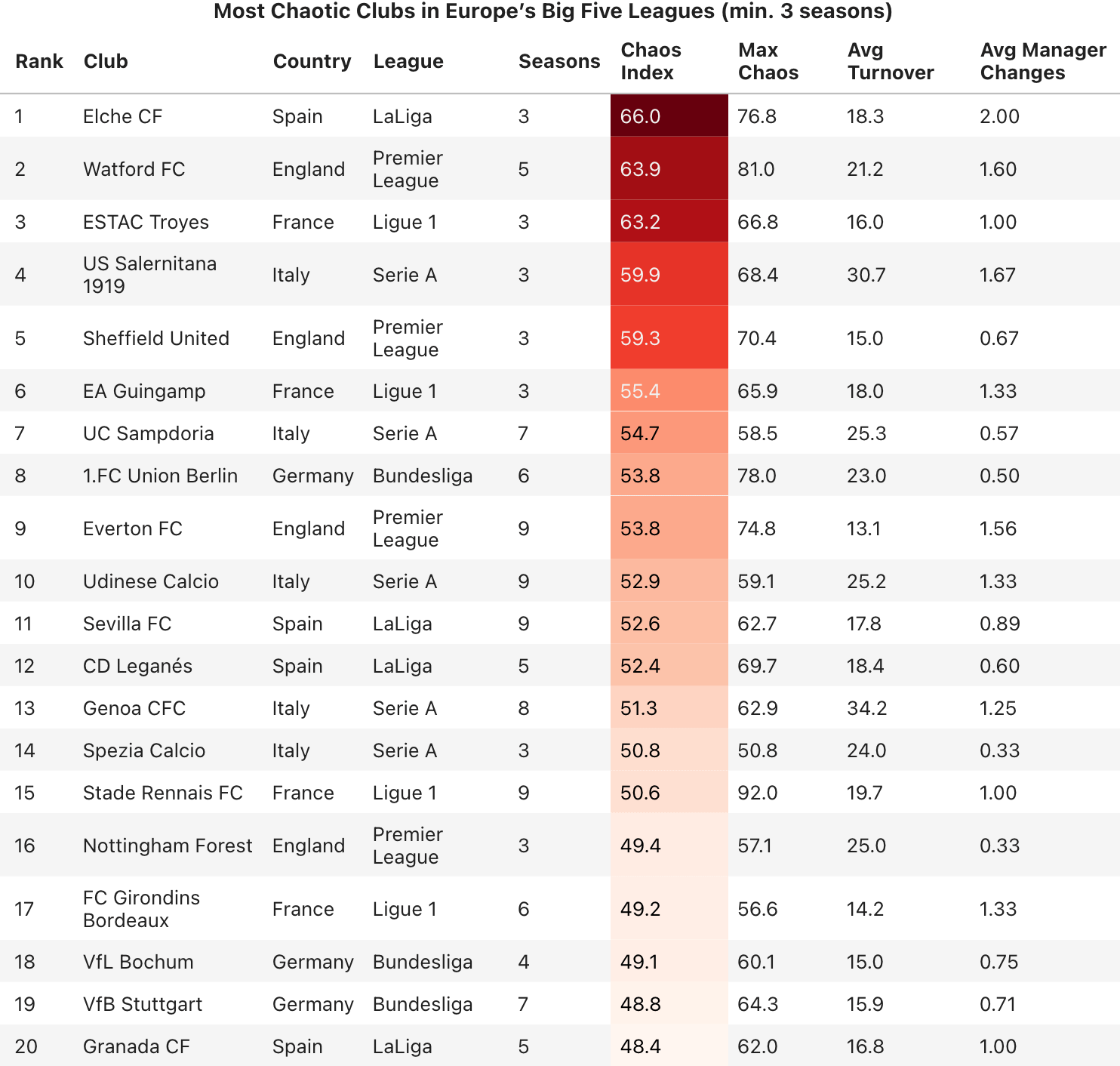
Chaos in elite leagues rarely looks like collapse.
Instead, it shows up as persistent instability – moderate managerial turnover combined with frequent squad rebuilds. Clubs don’t fall apart overnight. They drift.
What stands out most is that chaos in elite leagues rarely looks like collapse. It looks like instability.
Elche
A club caught in the promotion–relegation cycle. Instability here is driven less by constant managerial change and more by repeated squad rebuilds, as each season resets expectations.
Sheffield United
A good example of how instability follows rapid change. Promotion, tactical identity shifts, and squad turnover combine to create friction that’s difficult to resolve.
Salernitana
Heavy squad churn with short planning horizons. A profile that appears consistently across chaotic clubs in southern European leagues.
But the more interesting cases are less obvious.
Everton
Not extreme in any single season, but across multiple years the combination of managerial changes and inconsistent recruitment builds persistent instability.
Sampdoria
A slow drift rather than a collapse. Recruitment misalignment accumulates over time, gradually eroding structure.
Sevilla
A fascinating case. Historically one of the most stable and successful recruitment models in Europe, now showing signs of increasing volatility. A reminder that even elite systems can drift.
Union Berlin
An outlier. A club built on strong identity and structure, but where recent scaling – both tactically and in squad building – introduces early signs of instability.
These are not isolated cases. They are patterns. Across leagues, the same signals repeat:
-
– high squad turnover
-
– shifting recruitment strategies
-
– compressed planning horizons
And crucially, the chaos isn’t always dramatic. Sometimes it’s slow. Incremental. Accumulating just enough friction each season to quietly pull performance down over time.
Tottenham as a case study
Tottenham don’t appear at the extreme end of the chaos rankings. But that’s exactly the point. They sit in the middle.
Not stable enough to build sustained success.
Not chaotic enough to force a full reset.
And when you look at the data, that middle ground becomes very clear.
From 2016 to 2018, Tottenham were one of the most stable clubs in the league:
-
Chaos Index: 21.7 → 24.2 → 13.7
-
No managerial changes
-
Low turnover
This is the Pochettino period – high performance, strong identity, and structural alignment. Then the shift begins.
2019 is the inflection point:
-
Chaos Index jumps to 40.7
-
First managerial change
-
Turnover increases
From there, instability doesn’t explode, it accumulates.
-
2021: Chaos peaks at 44.9
-
2022: drops back to 26.7
-
2024: rises again to 30.6
This isn’t constant chaos.
It’s fluctuating instability – just enough change to disrupt, not enough to reset.
Since Pochettino, the club has cycled through:
-
– Mourinho
-
– Mason
-
– Nuno
-
– Conte
-
– Stellini
-
– Mason
-
– Postecoglou
-
– Frank
-
– (now) Tudor
Each bringing a different tactical identity. Each shaping recruitment in their own image. Each shifting the structure slightly. The result isn’t collapse, it’s drift.
A squad built across multiple visions, with just enough change each season to prevent full alignment.
Which brings us back to Tottenham now. Right now, Spurs feel chaotic. But the chaos isn’t new – it’s accumulated.
The spike doesn’t happen all at once.
It builds across seasons – through small shifts in recruitment, coaching, and structure.
Eventually, it becomes visible. Tottenham today may not be experiencing sudden instability.
They may simply be experiencing the delayed cost of several seasons of drift.
The hidden nature of chaos
One of the most interesting aspects of this analysis is timing.
Chaos doesn’t always hurt immediately. Clubs can survive unstable seasons, sometimes they even succeed. But the consequences tend to appear later. By the time performance drops, the cause is often no longer obvious.
– The manager has changed.
– The squad has evolved.
– The context looks different.
But the underlying instability remains.
A final thought
Right now Tottenham look chaotic.
Igor Tudor is trying to impose order.
But the data suggests something important.
Chaos isn’t a moment, it’s a build-up.
And in football, by the time you realise you have a chaos problem…
you’re usually already living with the consequences of it.